In Charity and Truth by Pope Benedict XVI
Friendship: The Key to the Evangelization of Men by Fr John McCloskey
Summary
- The pursuit of loneliness
- Causes and symptoms
- What is friendship?
- Friendship in Revelation
- Apostolic friendship
- 1. How many true friends do I have?
- 2. How many friends would lay down their lives for me, and I for them?
- 3. How many people are there to whom I can go to open up my heart and soul with total trust?
- 4. If I were to die today, how many people would care–would miss me for more than a few days? How many would come to my funeral?
- 5. How many lives were changed in a positive way by my friendship?
- 6. How many person were reconciled, converted, or grew in the life of the Church on account of my friendship?
- 7. Finally, are my friendships a fundamental part of my prayer life? Do I talk about my friends–pleading for their needs and trying to better my understanding of them, with The Friend?
- The example of the saints
- Being a friend
What is friendship?
Before considering a cure, we should give at least some quick consideration to the essence of friendship, how the ancients saw it, and how it became elevated by Christianity to a still greater good that is a necessary and natural means of evangelization. Friendship, of course, is a natural good in itself, inasmuch as man is a social creature. "It is not good for man to be alone." That Biblical observation applies not only to marriage but also to man's relationships with his fellow men. Any human person, formed in the image of Holy Trinity, exists in relation to others and indeed is defined by his relationships. For the vast majority of men, aside from his marriage and his family, the most important relationships will be friendships with other men. (There can also be forms of friendship between men and women outside marriage, but for the man committed to a life of apostolic celibacy or for a man already committed to one woman, these friendships normally have to maintain a certain distance and reserve.)We might say that friendship is a social relation that is distinguished by mutual affection. Love does not necessarily demand reciprocity, but friendship requires it. It takes two to form a friendship. The bond thus formed without question represents one of the most noble aspects of human life; it both presupposes and fosters other human virtue, such as selfless giving, understanding, compassion, and the spirit of collaboration. True friendship carries with it an "exchange of gifts." John Paul II has also used this expression to describe "dialogue"–which, he reminds us, is one of the principal means of creating a friendship. There can be no friendship without communication–normally a simple conversation of some sort, verbal or written.
Two of the greatest writers of classical antiquity placed the highest value on human friendship. Aristotle tells us in the Nicomachean Ethics: "Without friends, no one would choose to live, though he had all other goods... it would seem actually impossible to be a great friend of many people; love ideally is an excess of friendship and that can be felt towards only one person; therefore great friendship too can be felt towards few people." Yet Aristotle could not imagine how the added power of divine grace would enable men such as the saints, to love each other with the infinite power of the heart of Christ.
Cicero, in his treatise On Friendship, tells us "Friendship can only exist between good men. For there is nothing more loveable than virtue," and also, "I can only advise you to prefer friendship to all other things within human attainment."
The Christian philosophers and theologians also speak to us of the importance of friendship. St. Augustine tells us in a startlingly direct way, "No one can be known for who he is except through the friends he has." St. Augustine's mentor, St. Ambrose, says that "a friendship that can end was never a real friendship." St. Thomas Aquinas, the Angelic Doctor, writing in his treatise On Charity tells us: "Perfect friendship is not directed toward many.... but inasmuch as friendship toward one becomes more perfect as regards that one, the more perfect the love we have toward one, the better we are able to love others." He also adds, in his commentary on the Nicomachean Ethics, "It is proper of a friend to do good to his friends, principally to those most in need."
Being a friend
There is an old expression: To make a friend, be a friend." It is important to make a distinction between "acquaintances," of whom we may have hundreds or thousands, and "friends." Friendship is a sacred word, full of meaning, and one I do not use lightly. Friendship, ideally, is forever. Friendship requires spending time with another. There are no short cuts. Whether it is at meals, or a shared interest in sport or a hobby, or even during a pilgrimage, we need to share who we are and what we have to give, in order to receive the same gift from our friend.Certainly friendship may grow through correspondence, but in one way or another, we have to be "present" to our friends. We cannot really say that true friendship exists until we have opened up the deepest human questions: who man is, where he comes from, where he is headed, the meaning of life, the value of suffering. True friends talk about what is most important to them: faith, family, work. And this exploration of serious topics helps friendships to become apostolic. Such friendships lead men to grow and be transformed in Christ, with the inevitable result of creating a Christian environment (whether small or large) around them. Friendship also means loving our friends with all their faults; we forgive them when necessary, and although out of charity, from time to time, we correct them.
Strong male friendship must be revived if Catholic men and their progeny are to get on with the holy and ambitious task in this young millennium: to build the civilization of love and truth in the 21st century. To be sure we need many holy, courageous, and zealous bishops and priests, who will preach the word of Christ and administer his sacraments, deeply influenced by the message of the Second Vatican Council and its authentic interpretation. I am confident we will get them. However, the Gospel will be most effectively spread throughout society not from the sanctuary of the local parishes but through friendship.
Radio Replies by Rumble and Carty
Finally.... good to see these online. When did all this stuff get there? :)
Radio Replies First Volume - Fathers Rumble (Sydney, Australia) & Carty (St. Paul, Minnesota; USA)
1938. Imprimatur Joannes Gregorius Murray, Archiepiscopus Sancti Pauli. The first of three. A classic. Often recommended and consulted source of apologetic material.
Radio Replies Second Volume - Fathers Rumble & Carty
1940. Imprimatur Joannes Gregorius Murray, Archiepiscopus Sancti Pauli. The second of three. A classic. Often recommended and consulted source of apologetic material.
Radio Replies Third Volume - Fathers Rumble & Carty
1941. Imprimatur Joannes Gregorius Murray, Archiepiscopus Sancti Pauli. The third of three. A classic. Often recommended and consulted source of apologetic material.
Radio Replies Fourth Volume - Fathers Rumble & Carty
Radio Replies Fifth Volume - Fathers Rumble & Carty
See also: http://www.radioreplies.info
Introduction to the Devout Life by St. Francis de Sales (Church Doctor)
This book has a few specific chapters on friendship that are very very valuable.
Download this handy PDF for A4 paper:
- http://sites.google.com/site/catholiclifetimereadingplan/file-cabinet/intro_devout_life_brief.pdf (emphasis on the practice of virtues and friendship)
- Full version at a respectable website: http://www.catholictreasury.info/books/devout_life/
English translation- Also show original French results | Original French |
Intro to the Devout Life (google)Intro to the Devout Life (babelfish)INTRODUCTION TO LIFE DEVOTION. Of Saint Francis de Sales. Full text, published after the edition of 1619. INTRODUCTION TO LIFE DEVOTION...www.abbaye-saint-benoit.ch/ | Intro to the Devout Life (original french)INTRODUCTION A LA VIE DÉVOTE. DE SAINT FRANCOIS DE SALES. Texte intégral, publié d’après l’édition de 1619. INTRODUCTION A LA VIE DÉVOTE ... www.abbaye-saint-benoit.ch/ |
Royal Scholars to the King become Catholic
September 20th is dedicated to the memorial of St Andrew Kim Taegon, St Paul Chong Hasang, and their companions. Breaking with tradition in 1984, Pope John Paul II canonized 103 saints, not in Rome, but in Korea. Korea is the only place in the world to become catholic through books and the grace of Jesus Christ. When catholics in Korea asked for a priest in a letter to Rome, the pope did not know where Korea was. Many of these scholars ended up being killed. Why?
As I struggle with PDF files in the creation of catholic content, it dawned that I should consider the intercession of the Korean saints, co-workers through and with Jesus Christ, in the unity of the Holy Spirit. When looking for a public domain portrait of the 103 saints, I came across something of happy memory:
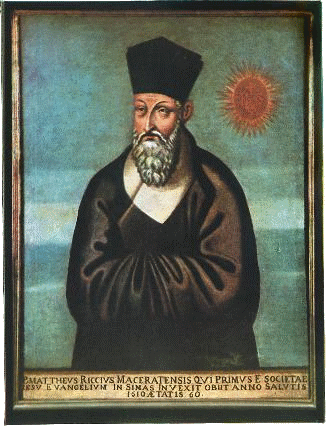
The True Meaning of the Lord of Heaven by Matteo Ricci (Popular among scholars of the royal court in Korea)
Thanks to "西儒 ─ The Western Confucian" for making the Korean feastday worthwhile this year. ("To put the world in order, we must first put the nation in order; to put the nation in order, we must put the family in order; to put the family in order, we must cultivate our personal life; and to cultivate our personal life, we must first set our hearts right" ─ Confucius.)
True Meaning of the Lord of Heaven (Jesuit Primary Sources in English Translations Series I : No. 6)
The Wise Man From the West : Matteo Ricci and his Mission to China
Roman Catholic Church in Korea: Korean Martyrs, Myeongdong Cathedral, Jeoldu-San, Roman Catholic Archdiocese of Daegu, Bishop of Pyongyang
The Korean Martyr Saints - Founders of a Church
Current Philosophical Trends Challenging an Absolute Truth: Investigating Faith and Reason
- 05-28min -- "Positivism: Old Age and the Value of Life" by Kirsty McKillop? Further reading: "Tuesdays with Morrie" by Mitch Albom
- 28-32min -- Questions given to Kirsty
- 32-49min -- "Relativism" by Katrina George, a lecturer in law at the University of Western Sydney and a director of Women's Forum Australia, an independent think tank that conducts research, education and public policy on women's issues.
- 49-56min -- Questions to Katrina: Basic needs vs basic goods. Recommended reading Robert George (books on natural law), Q: Catholic Church "holds the fullness of Truth". Institutional structure give the splendor of truth? ie. slavery. Q: Freedom of religion and law, A: More trust in reason, basic goods
- 56-1:26min -- "Freedom and Truth" by Patricia AUT management commerce law northland ethics. Free will, happiness (to be loved and to love properly), love requires freedom, erroneous views of freedom, tolerance and truth, relativism and truth.
- "Truth is God. Truth is a Person and someone we can choose to trust and to love. Authentic freedom is choosing God and allowing ourselves to be taught by God and to follow His Will." -- Pope Benedict XVI
- Tolerance is compatible with an absolute truth.
- Intellect and reason should be used in searching for that truth.
- Freedom is to choose and love the truth.

See also:
"In the Grip of Vice: Tearing the Soul from Virtue" by Professor Hayden Ramsay
"Have you noticed how often the call for freedom is made without ever referring to the truth of the human person? Some today argue that respect for freedom of the individual makes it wrong to seek truth, including the truth about what is good. In some circles to speak of truth is seen as controversial or divisive, and consequently best kept in the private sphere. And in truth's place -- or better said its absence -- an idea has spread which, in giving value to everything indiscriminately, claims to assure freedom and to liberate conscience. This we call relativism. But what purpose has a "freedom" which, in disregarding truth, pursues what is false or wrong? How many young people have been offered a hand which in the name of freedom or experience has led them to addiction, to moral or intellectual confusion, to hurt, to a loss of self-respect, even to despair and so tragically and sadly to the taking of their own life? Dear friends, truth is not an imposition. Nor is it simply a set of rules. It is a discovery of the One who never fails us; the One whom we can always trust. In seeking truth we come to live by belief because ultimately truth is a person: Jesus Christ. That is why authentic freedom is not an opting out. It is an opting in; nothing less than letting go of self and allowing oneself to be drawn into Christ's very being for others (cf. Spe Salvi, 28)." -- [Pope Benedict XVI Meeting with Seminarians and Youth at St Joseph's Seminary; Dunwoodie, New York; April 19, 2008]
The New Jerusalem Bible, Douay-Rheims, Navarre Bible Series, Haydock Commentary...
The New Jerusalam Bible (NJB) is the first catholic Bible that has made me generally happy since converting. The footnotes at the bottom of each page and cross-references in the margin are worthwhile. The translation and notes also seem better than the RSV (Revised Standard Version) and the New American Bible (NAB). The NAB is my least favorite edition. The Douay-Rheims Bible is good for translation, but sharing it with others without a taste for archaic forms of English is a bit of a problem.
The Navarre Bible series is great and preferred as a starting point for commentary, but I don't own the whole set...and the New Jerusalem Bible is more portable and attainable at 2000 pages. For the curious, the Haydock's Catholic Bible Commentary (1859 edition) is available online.
The versions of the Bible that I used while young were: (in order of preference, but I used them all simultaneously nearly verse by verse)
- The King James Version (helped by a Webster's Collegiate Dictionary, 8th edition (1970-1980))
- The Picture Bible by Iva Hoth (can help for clarifying people/events in your head)
- A Children's Literature Bible (It was a complete Bible and somehow seemed more comprehensive/explicit than the "Good News Bible".)
- The Good News Bible (with those odd stick-like figure drawings)